
NH
Northern HeadwatersWho Operates and Manages this LTAR Site?
The Northern Headwaters (NH) LTAR project includes two cooperating sites in Minnesota: The Soil and Water Management Research Unit (SWMRU) located in St. Paul, and the North Central Soil Conservation Research Laboratory (NCSCRL) in Morris.
USDA-ARS scientists in Minnesota are working across locations and partnering with University collaborators, local producers and other stakeholders to conduct research focused on environmental impacts associated with agricultural production challenges unique to the Upper Midwest. They are working to develop solutions for farmers and other stakeholders aimed at preserving agricultural productivity while also maintaining or improving soil, air, and water quality. With these partnerships plot- and field-scale studies conducted use practices such as reduced tillage, expanding the number of crops grown in a rotation, and including cover crops or intermediate oilseeds that provide winter cover and harvestable oilseeds. Additional research investigates the viability of integrating perennial living mulches into more traditional corn and soybean agriculture.
Description
Minnesota is a state known for its many lakes and streams, including the headwaters of the Red River of the North as well as the Mississippi River. Water draining these basins flows through productive agricultural landscapes supported by rich glacial and lacustrine soils of the Upper Midwest. Farmland in the region supports intensive production of corn, soybeans, canning crops, and large confined animal feeding operations, including dairy, hogs, beef, and turkeys. However, typical farming practices here carry risks related to soil and nutrient losses that threaten both agricultural productivity and environmental quality. USDA-Agricultural Research Service scientists from two research locations in Minnesota are working within the LTAR network to study production challenges unique to the Upper Midwest and develop solutions for farmers and other stakeholders in the region.
The Northern Headwater sites at both St. Paul and Morris, MN maintain long-term experiments across a variety of locations to study how alternative agricultural production practices can impact soil health and crop productivity. Additional field- and watershed-focused studies aim to understand the role that small ditches and streams can play to influence downstream water quality. Long-term studies utilize eddy covariance techniques to characterize crop evapotranspiration and help determine water budgets at the field scale. These datasets help to understand the factors that may contribute to the challenges or success of alternative cropping systems such as the use of kura clover as a permanent living mulch being tested at Rosemount, MN (Fig 1) and alternative soil tillage practices at both locations (Fig 2).
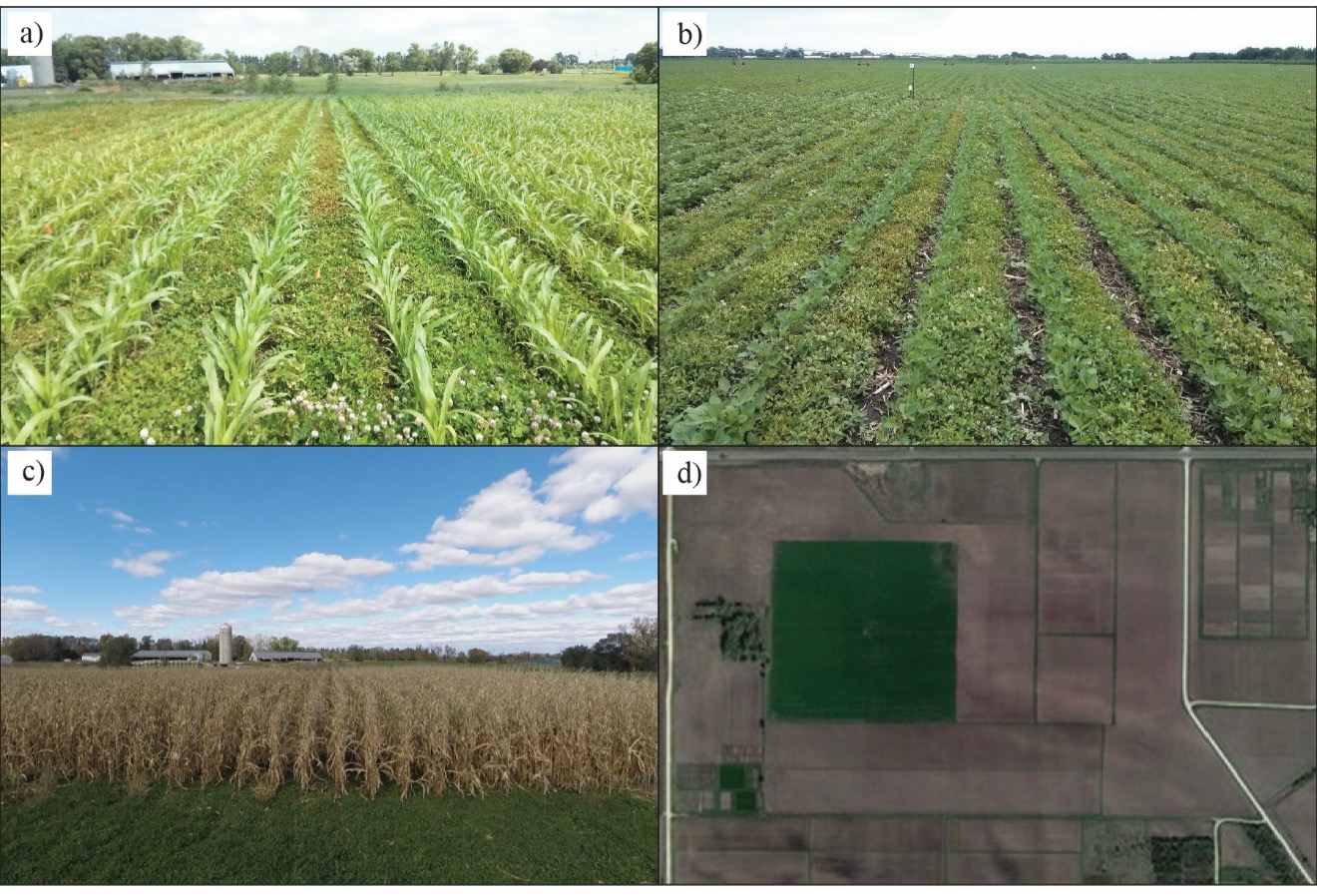
Figure 1. (taken from Dalzell et al., 2024) Examples of the kura clover living mulch system being evaluated as the alternative practice at the Long-Term Agroecosystem Research (LTAR) site in Rosemount, MN, for the Croplands Common Experiment. Early season corn (a) and soybean (b) crops planted into established stands of kura clover; late season corn prior to harvest showing living mulch at the field edge (c) and a Google Earth aerial photo of a kura clover stand on April 3, 2012 (d), illustrating how this practice can contribute to soil cover in cultivated landscapes at times of the year when conventional row crop fields are bare.
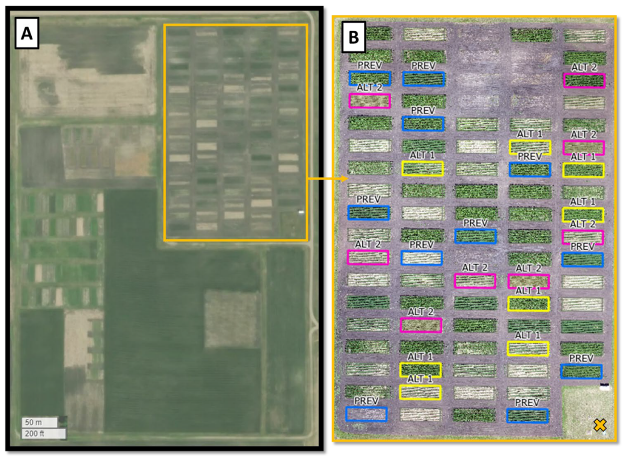
Figure 2. (taken from Johnson et al., 2024) Schematic of plot-scale studies of the long-term impacts of crop rotation, cover crops, and soil tillage on soil health and agronomic productivity.
Geography
The productive agricultural soils of the NH site are primarily formed from vast glacial and lacustrine deposits that are common throughout Minnesota. Prior to the arrival of European settlers, the prairie landscape contained small ponds and wetlands known as prairie potholes. Agricultural expansion across the region was accompanied by extensive ditching and installation of subsurface drainage systems (also referred to as tile drainage). These changes helped to improve agricultural productivity but were also accompanied by changes in hydrology and increased nutrient loss from cultivated fields.
Instrumentation
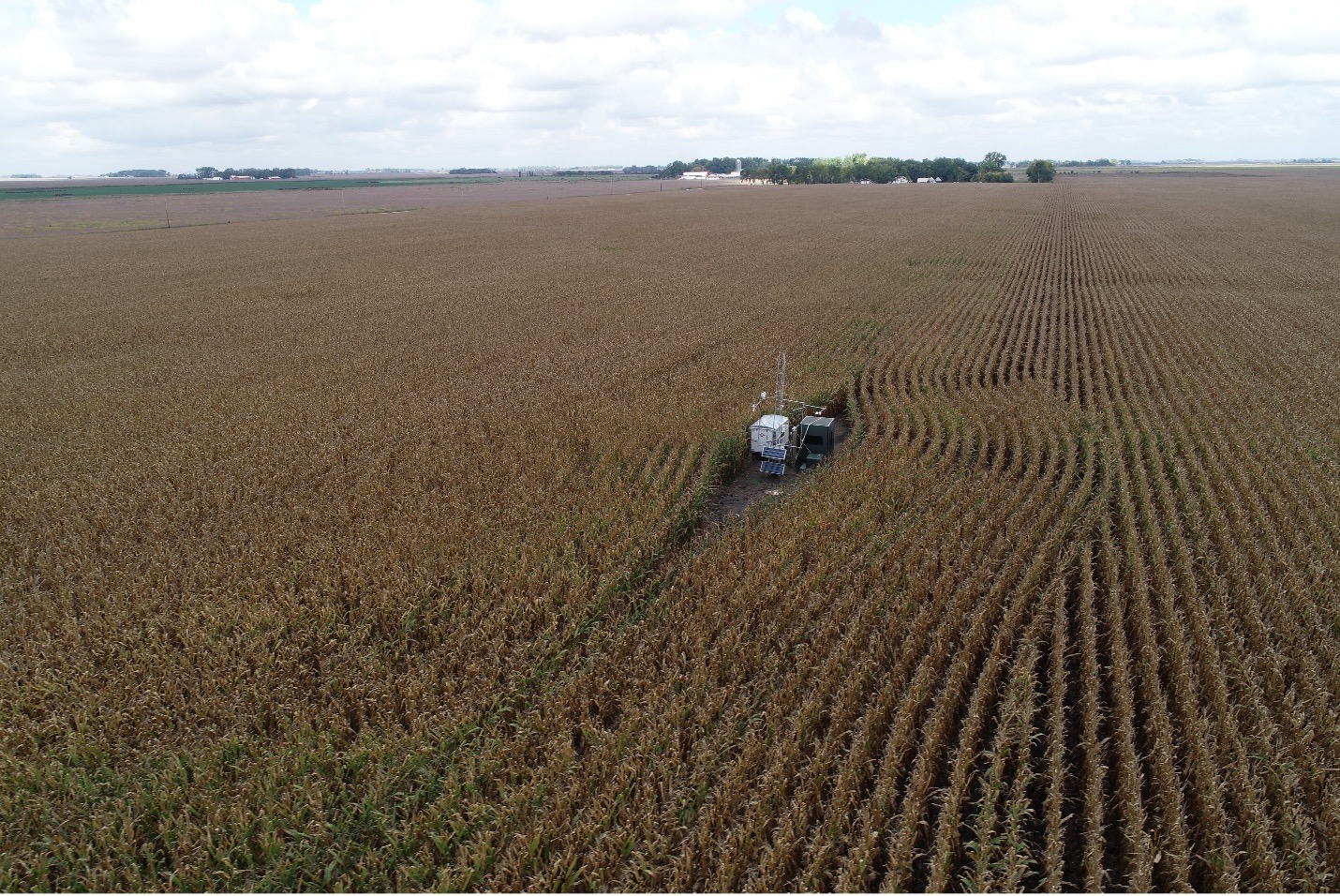
Our long-term instrumentation suites are placed in cultivated fields that reflect the prevailing corn and soybean agriculture of the Midwestern US Corn Belt as well as fields with alternative management practices including diversified crop rotations, intermediate oilseeds, reduced tillage, and kura clover as a perennial living mulch. Instrumentation at NH sites in Rosemount and Morris, MN includes eddy covariance towers and accompanying environmental instrumentation to provide continuous records of CO2 & H2O flux along with phenocams to record crop phenology, and meteorology, soil moisture, and soil temperature measurements.
Watershed based sampling is conducted from fixed-point monitoring locations as well as periodically from a small kayak or pack raft. Instrumentation for stream water-based sampling relies on a suite of optical sensors coupled with GPS units to develop maps of water quality for a snapshot in time.
Classification System
Farm Resource Regions: Heartland& Northern Crescent
Hydrologic Unit Codes (HUC-2): 07 – Upper Mississippi River, 09 – Souris-Red-Rainy
National Ecological Observatory Network (NEON): Domain D5 -Great Lakes & D6 – Prairie Peninsula
NRCS Major Land: 56A – Glacial Lake Agassiz, Red River Valley; 102A – Rolling Till Prairie; 103 – Central Iowa and Minnesota Till Prairies; 104 Eastern Iowa and Minnesota Till Prairies
LTAR Research Emphases
- Alternative crop rotations that are productive, sustainable and provide ecosystem services.
- Carbon, water, and energy measurements with flux towers.
- Crop rotations, cover crops, and perennial living cover.
- Reduced tillage.
- Biogeochemistry of agricultural watersheds.
Collaborators
The Northern Headwaters LTAR site enjoys collaborations across the LTAR network and especially with our neighboring locations in the Upper Midwest including, the National Lab for Agriculture and the Environment in Ames, IA; the Northern Great Plains Research Laboratory in Mandan, ND, and the Pioneer Farm at the University of Wisconsin, Platteville, WI. There are several other ARS and non-ARS collaborators, University partners, State Agencies, farmers, and other stakeholders who partner with ARS scientists in St. Paul and Morris.
Other Networks (where data is shared)
- Ameriflux
- National PhenoCam Network.
- GRACEnet
- REAP
- Soil Biology Network
- Ag Data Commons
Site Common Experiment
Dalzell, B. J., Baker, J. M., Venterea, R. T., Spokas, K. A., Feyereisen, G. W., Rice, P. J., & Alexander, J. R. (2024). The LTAR Cropland Common Experiment at Upper Mississippi River Basin–St. Paul (Vol. 53, No. 6, pp. 1008-1016). https://doi.org/10.1002/jeq2.20615
Johnson, J. M., Helseth, C. M., Weyers, S., Papanicolaou, T., & Busche, D. (2024). The LTAR Cropland Common Experiment at Upper Mississippi River Basin–Morris (Vol. 53, No. 6, pp. 989-998). https://doi.org/10.1002/jeq2.20631
Site Name
Northern Headwaters
Website
Location
- NH – Morris, MN
- NH – St. Paul, MN
Established
1990 (Walnut Creek-North), 1992 (Brooks), 2000 (Kelley), 2001 (South Fork), 2016 (Coles/Williams)
Area (km2)
6200
Leader(s)
Sharon Weyers (Morris, MN), Brent Dalzell (St Paul, MN)





ABOUT LTAR
The USDA Agricultural Research Service (ARS) Long-Term Agroecosystem Research network consists of 18 Federal and university agricultural research sites with an average of over 50 years of history. The goal of this research network is to ensure sustained crop and livestock production and ecosystem services from agroecosystems, and to forecast and verify the effects of environmental trends, public policies, and emerging technologies.