
Project: AgPICKS: Agricultural Performance Indicator and Context Knowledge System
System Development
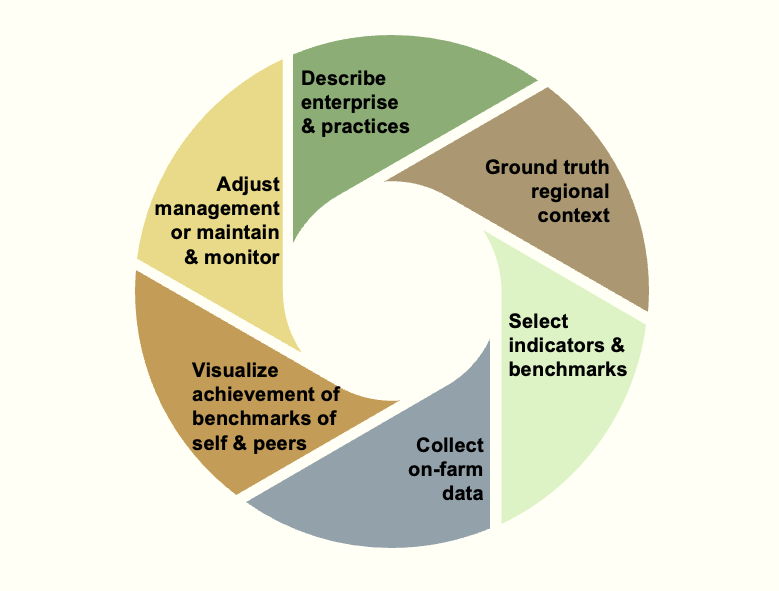
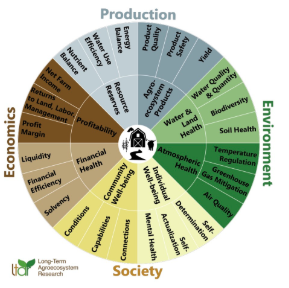
Concepts for indicators and metrics have evolved since 2018, first at national network meetings and later with a formalized consensus process. The architecture of the system has been developed since 2020 in the multidisciplinary Indicators Working Group. The system is intended to eventually explore indicators at multiple scales (e.g.,nation, region, landscape, farm/ranch, field). We are currently focusing on the farm/ranch scale to connect and standardize LTAR Common Experiment measurements, as well as to provide tools for other scientists and producers working at the farm/ranch scale. We have designed the farm-level system to be holistic, inclusive, outcomes-based, farmer informed, and infused with on-farm data collection.

System Architecture (2024)
The system for the farm/ranch level is designed to:
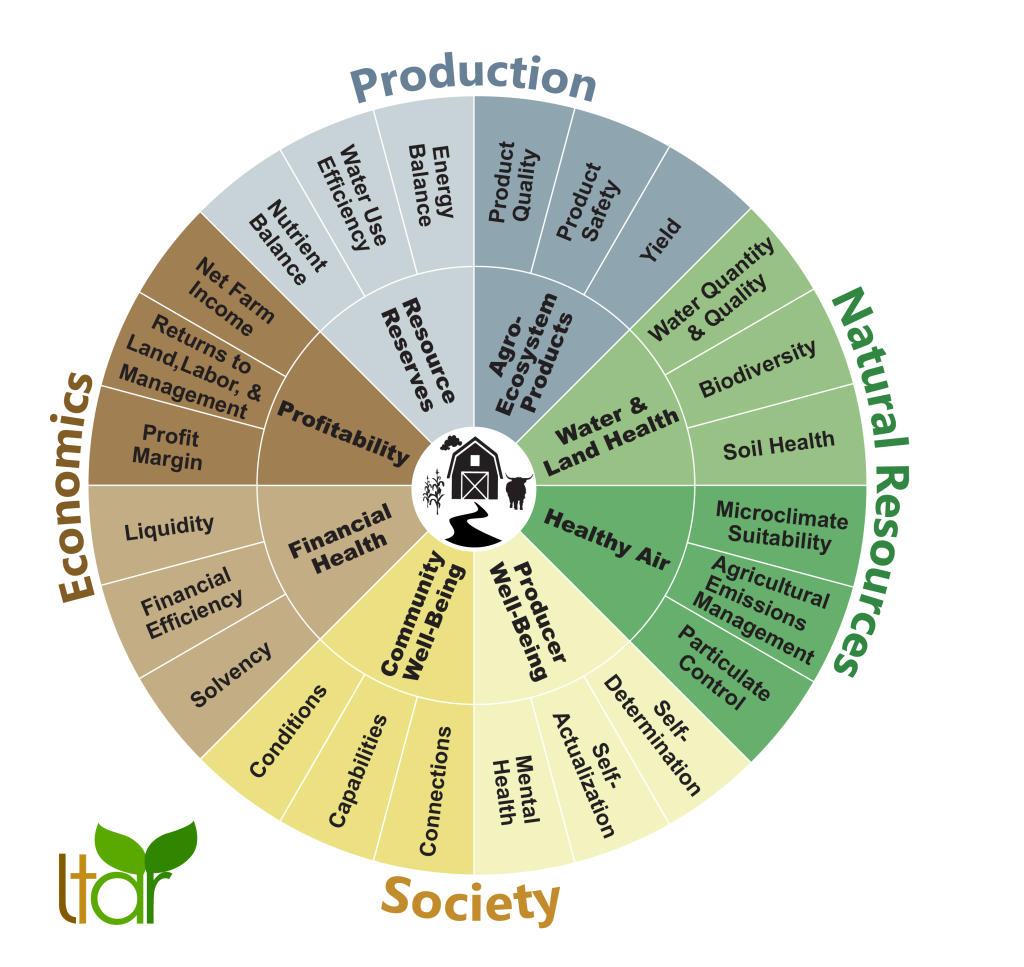
- Promote the understanding of tradeoffs of agricultural systems among four domains of Production, Environment, Society, and Economics.
- Allow users to select metrics per indicator, including options that don’t require formal scientific training. Metrics recommended by the Common Experiment teams and Working Groups will be prioritized to enable coordination among Common Experiment scientists.
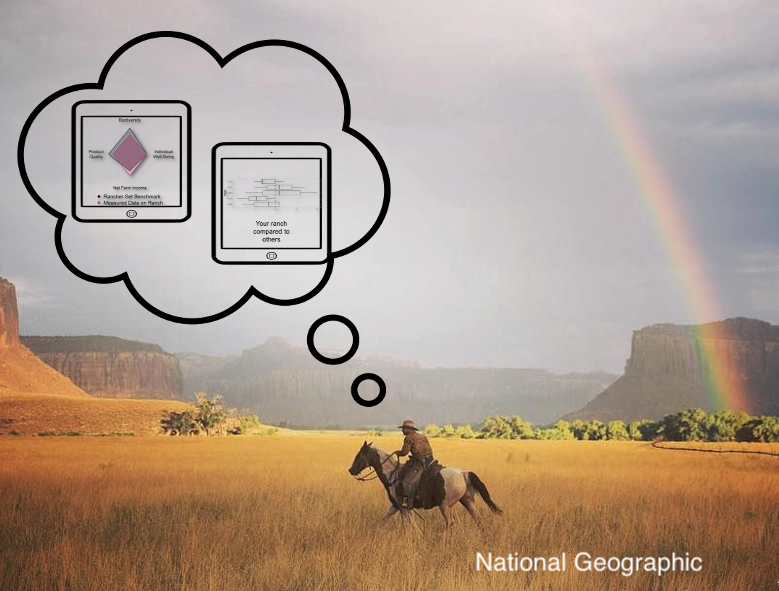
- Be used with a peer-to-peer benchmarking tool built to help users understand how well their agricultural systems perform in relation to their own goals, and in relation to other systems in the database.
- Be understood in contexts of communities, supply chains, regions, and regimes as defined by the Human Dimensions, Modeling, Regionalization, and Resilience Working Groups. Farm/ranch-level indicator data will also be designed to inform models at these scales.
- Evolve according to evolving modeler and stakeholder needs and preferences.



LTAR Performance Indicators v.2025
Workplan
The project is operating on a 5-year workplan in coordination with the 2022 LTAR Strategic Plan. The Indicators Working Group opened the floor for a round of suggestions on Framework v.2022. The Indicators
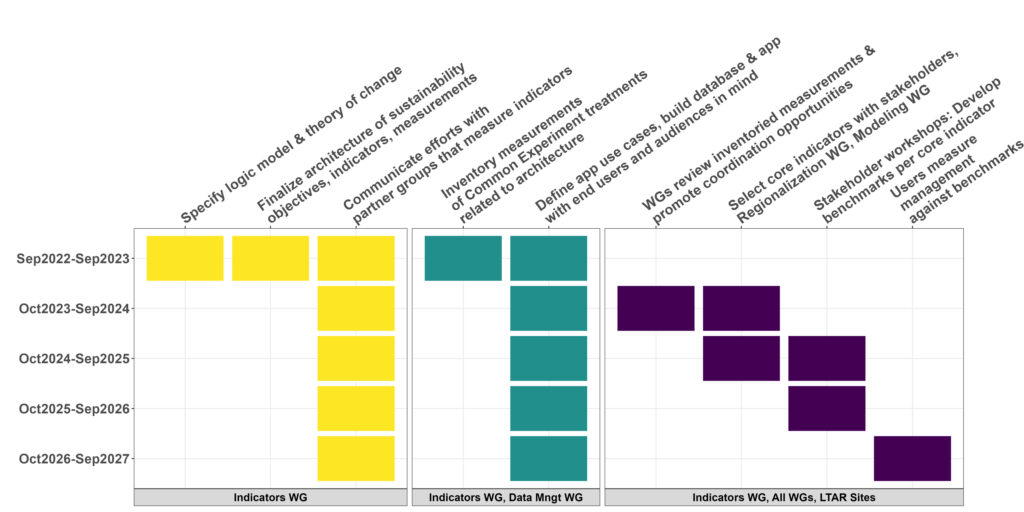
Working Group considered all input to develop a new consensus-based version (v.2024) to be used to build a suite of user tools in the Agricultural Performance Indicator and Context Knowledge System (AgPICKS).
Publications
- DeLong, A.N., McIntosh, M.M., Donovan, M., Spiegal, S.A., Boughton, E.H., Swain, H.M., Silveira, M.L., Sellers, B., Hurst, Z.M., Bestelmeyer, B.T., 2025. Engaging stakeholders to strengthen coproduction of knowledge in the Long‐Term Agroecosystem Research (LTAR) indicator framework. J of Env Quality 54, 1515–1534. https://doi.org/10.1002/jeq2.70102
- Donovan, M., Spiegal, S., Kaplan, N., Archer, D., Bean, A., Beebout, S.E.J., Bestelmeyer, B.T., Clark, P., DeLong, A., Fortuna, A., Friedrichsen, C.N., Hoover, D.L., Huggins, D., Kleinman, P.J.A., McIntosh, M.M., Renschler, C.S., Ritten, J., Smith, D.R., Webb, N.P., Wulfhorst, J.D., 2025. Selecting performance indicators for farms and ranches engaged in collaborative agroecosystem research. J of Env Quality jeq2.70051. https://doi.org/10.1002/jeq2.70051
- Friedrichsen, C., Wilmer, H., Wagner, C.H., DeLong, A., 2025. Soil health and community well‐being: A framework of intangible outcomes of sustainable agriculture. J of Env Quality 54, 1214–1229. https://doi.org/10.1002/jeq2.70049
- Kaplan, N.E., Armendariz, G., Azad, S., Carlson, B.R., White, W.A., Abendroth, L.J., Coffin, A.W., Gordon, V.S., Maul, J.E., Osterholz, W., Sears, J., 2025. Five foundational tools for managing metadata from the USDA Long‐Term Agroecosystem Research (LTAR) Network. J of Env Quality 54, 1230–1244. https://doi.org/10.1002/jeq2.70027
- Liebig, M.A., Abendroth, L.J., Robertson, G.P., Augustine, D., Boughton, E.H., Bagley, G., Busch, D.L., Clark, P., Coffin, A.W., Dalzell, B.J., Dell, C.J., Fortuna, A., Freidenreich, A., Heilman, P., Helseth, C., Huggins, D.R., Johnson, J.M.F., Khorchani, M., King, K., Kovar, J.L., Locke, M.A., Mirsky, S.B., Schantz, M.C., Schmer, M.R., Silveira, M.L., Smith, D.R., Soder, K.J., Spiegal, S., Stinner, J., Toledo, D., Williams, M., Yost, J., 2024. The LTAR Common Experiment: Facilitating improved agricultural sustainability through coordinated cross‐site research. J of Env Quality 53, 787–801. https://doi.org/10.1002/jeq2.20636
- Spiegal, S., Estell, R., Cibils, A., Cox, A., McIntosh, M.M., Browning, D.M., Duniway, M.C., Funk, M., Macon, L., McCord, S.E., Redd, M., Tolle, C., Utsumi, S., Walker, J., Webb, N., Bestelmeyer, B.T., 2024. The LTAR Grazing Land Common Experiment at the Jornada Experimental Range: Old genetics, new precision technologies, and adaptive value chains. J of Env Quality jeq2.20605. http://dx.doi.org/10.1002/jeq2.20605
- Spiegal, S., Webb, N.P., Boughton, E.H., Boughton, R.K., Brymer, A.L.B., Clark, P.E., Collins, C.H., Hoover, D.L., Kaplan, N., McCord, S.E., Meredith, G., Porensky, L.M., Toledo, D., Wilmer, H., Wulfhorst, J., Bestelmeyer, B.T., 2022. Measuring the social and ecological performance of agricultural innovations on rangelands: Progress and plans for an indicator framework in the LTAR network. Rangelands 44, 334–344. https://doi.org/10.1016/j.rala.2021.12.005
- Webb, N.P., Kachergis, E., Miller, S.W., McCord, S.E., Bestelmeyer, B.T., Brown, J.R., Chappell, A., Edwards, B.L., Herrick, J.E., Karl, J.W., 2020. Indicators and benchmarks for wind erosion monitoring, assessment and management. Ecological Indicators 110, 105881. https://doi.org/10.1016/j.ecolind.2019.105881
Recent Press

ABOUT LTAR
The USDA Agricultural Research Service (ARS) Long-Term Agroecosystem Research network consists of 18 Federal and university agricultural research sites with an average of over 50 years of history. The goal of this research network is to ensure sustained crop and livestock production and ecosystem services from agroecosystems, and to forecast and verify the effects of environmental trends, public policies, and emerging technologies.